
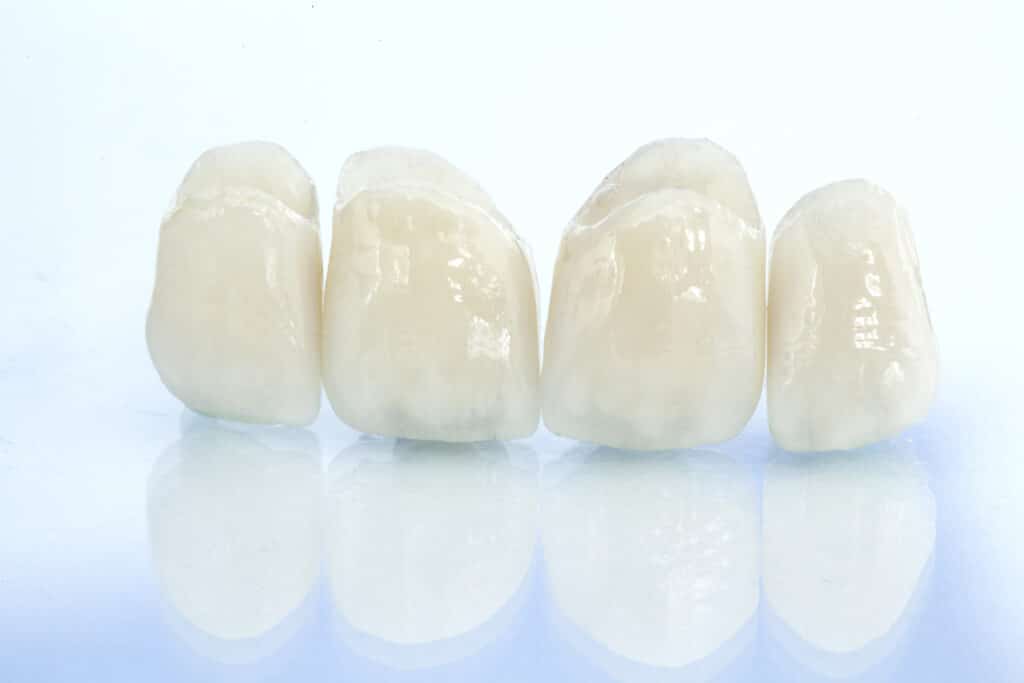
Zirconia-Based Crowns and Bridges
Zirconia dental crowns are used on severely damaged or previously prepared teeth to improve their appearance and health. We do not prepare any teeth for this procedure that have not already been reduced for a previous crown. Preserving the healthy tissue of the teeth should be one of the most important principles of dentistry, based on current knowledge.
In this system, zirconium a white alloy is used as the substructure instead of metal. This state-of-the-art substructure is the only material capable of combining aesthetics with durability. The system’s greatest advantage is that it achieves very high durability while also providing a fully aesthetic appearance for bridges in the posterior region.
For many years, a metal substructure has been used under porcelain crowns to ensure durability. Since the drawbacks of this metal substructure regarding the gums, dental tissue, overall health, and, most importantly, aesthetics are well known, the search for an alternative material to metal in porcelain restorations has been ongoing for years.
The use of zirconium which had previously been successfully employed in other fields of medicine as a replacement for porcelain-fused-to-metal restorations in dentistry has ushered in a new era. This is because these new zirconium-based porcelain crowns not only prevent gum problems and allergic reactions but also, thanks to their light-transmitting properties, allow us to achieve aesthetics and function that closely resemble those of natural teeth.
Today, efforts are being made to modify the structure of zirconia to make it more translucent and give it a more natural appearance. The results have been quite successful and satisfying. Zirconia materials with superior properties, produced by various manufacturers, are changing the perception that existing options are aesthetically inadequate.
What is a zirconia dental crown?
Restorations commonly known as “zirconium crowns” are crowns and bridges made from zirconia-based ceramics in dentistry. A crown surrounds the visible portion of a prepared tooth in the mouth, helping to restore the tooth’s shape, function, and appearance. The goal is not merely to achieve a whiter appearance; it is to plan a restoration that can protect the tooth along with its remaining healthy structure, withstand chewing forces, and harmonize with the surrounding tissues.
In what situations can it be considered?
Zirconia dental crowns can be considered for teeth with extensive tooth structure loss, fractured teeth, teeth weakened by large fillings, teeth requiring support following root canal treatment, or teeth previously prepared for a crown. Zirconia-based options may also be utilized in bridges and implant-supported restorations, depending on the clinical situation. However, not every discoloration, shape irregularity, or minor fracture requires a full crown. The suitability of more conservative alternatives such as fillings, bonding, inlays/onlays, veneers, or a different type of crown—should be evaluated during the examination.
How do you choose materials and designs?
During the planning phase, the remaining healthy tooth structure, gum health, occlusal relationship, chewing load, teeth clenching or grinding habits, the restoration’s position in the mouth, and aesthetic expectations are all evaluated together. Zirconia materials may have different properties in terms of durability and light transmission. When deciding between monolithic restorations—that is, single-piece restorations—and options with a ceramic layer applied on top, the anterior or posterior region, the existing cavity, and the opposing tooth are taken into account. For this reason, it is not accurate to speak of a single “best” type of zirconia for everyone.
Treatment process
The treatment process typically involves completing any necessary oral and gum treatments, properly preparing the tooth, taking an impression or digital scan, and placing a temporary restoration. The crown, which is fabricated in the laboratory, is tried in for color, shape, marginal fit, and occlusion. Once its suitability is confirmed, it is cemented to the tooth. The number of appointments and the specifics of the procedure may vary depending on the individual case.
In most cases, a certain amount of tooth structure must be prepared to place a crown; this procedure is irreversible. Therefore, the decision should be made only after discussing the expected benefits, potential risks, and more conservative alternatives. If the temporary crown becomes dislodged or if a noticeable height difference is felt during occlusion, the patient should contact the clinic. Since the color of the crown will not change with subsequent teeth whitening procedures, color planning can be evaluated in conjunction with other aesthetic procedures.
Maintenance and Service Life
A zirconia crown does not decay; however, the natural tooth beneath it and the gum tissue surrounding the crown require care. Regular brushing, flossing, and dental checkups help protect the restoration and surrounding tissues. Over time, complications such as cracking or breaking of the crown, weakening of the bond, decay at the margin, gum problems, wear on the opposing tooth, or sensitivity may occur. Lifespan depends on oral hygiene, bite alignment, habits, and clinical conditions; a fixed lifespan cannot be guaranteed. The suitability of a zirconia crown and the choice of material can only be determined on an individual basis following clinical and necessary imaging evaluations.